
Welcome, culinary adventurers, math-phobes, and anyone who has ever stared at a recipe, wondering if they need a science degree just to bake a cake! Are you ready to discover a world where measuring ingredients is actually fun? If you’re trying to figure out how to convert ml to grams, you’ve come to the right place.
This isn’t just your grandma’s cooking blog; this is your funny, friendly, and slightly nerdy guide to mastering the art of kitchen conversions! We know that stumbling over measurements is about as fun as a flat soda. That’s why we’ve turned the potentially boring task of converting ml to grams into a pun-derful adventure! Get ready to laugh, learn, and maybe even get a little bit smarter.
The “Weight” is Over! What’s All This About?
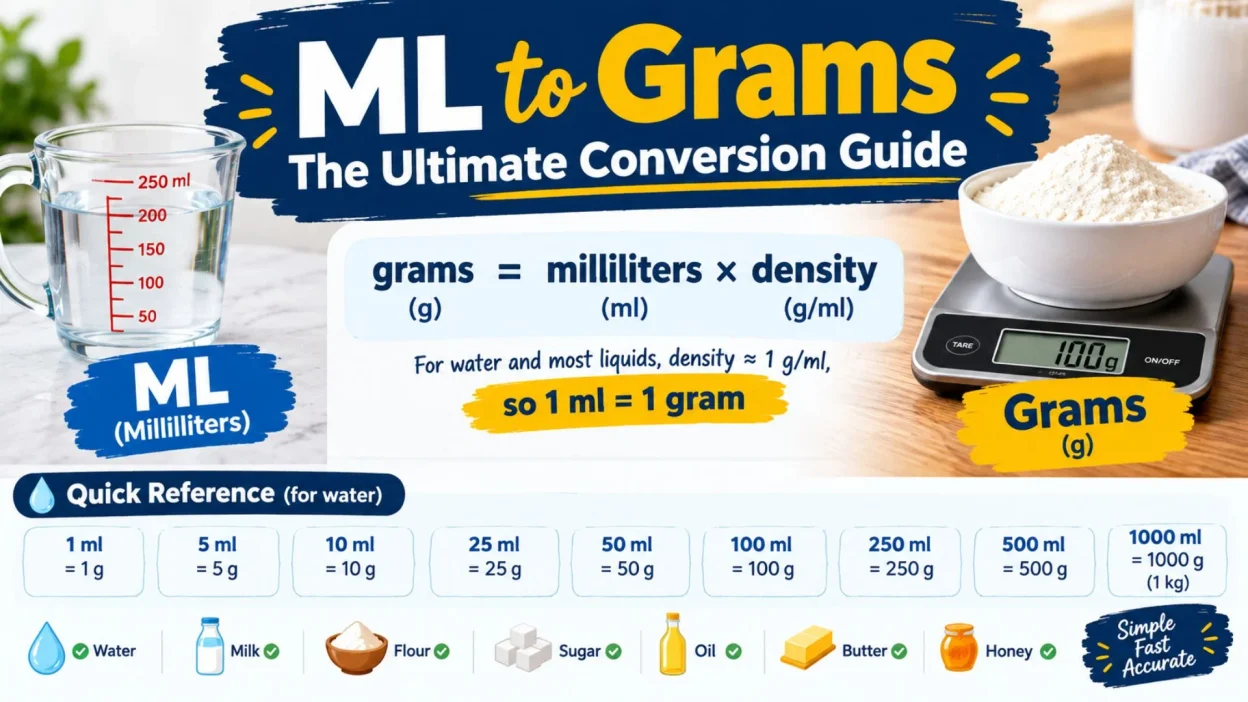
Think of milliliters and grams as two completely different species trying to become best friends. Milliliters (ml) measure volume – think of it as how much space a liquid takes up in your measuring cup. Grams (g) measure weight – how heavy something actually is on a scale.
Here is the big secret: they don’t always match up! It all depends on the “density” of the ingredient. This is the core of the ml to grams mystery.
If you want to be a hero in the kitchen, understanding ml to grams is your first step. Let’s make it “gram”-matically correct!
“Ml to Grams” 101: The Secret Formula
The golden rule to remember is: Grams = Milliliters × Density (g/ml) .
See? You’re basically a kitchen scientist now! This formula is the key to unlocking world-class cooking. But why can’t we just use one measurement for everything? Let’s find out!
“Ml to Grams” Comedians! 🎭
We’ve put together a collection of hilarious puns about ml to grams. These are perfect for your next cooking caption, a birthday card for a baker friend, or just to show off how witty you are!
🥛 Water You Waiting For? A H2O-larious Start!
Water is the “plain Jane” of the conversion world. For water, 1 ml to grams is a perfect 1:1 ratio . It’s the standard against which all other ingredients are measured. Here are some liquid laughs to start you off:
- Why did the water break up with the cup? Because it found a weightier relationship with the scale!
- What did the milliliter say to the gram? “We go together like water and… well, water!”
- Baking is a “liquids” game, but water always plays it straight.
- I tried to make a joke about converting ml to grams, but I didn’t want it to be too dry.
- Water is the only one that doesn’t have a “dense” personality.
- Why is water so good at math? Because it always gets the density right!
- What do you call a well-hydrated calculator? A water-converter!
🍯 Don’t be “Honey”, Don’t Be So Dense!
Honey is the heavy lifter of the kitchen. Because it’s so much denser than water, the ml to grams conversion is completely different. 1 ml of honey can weigh up to 1.42 grams . That’s a sweet, sticky weight to carry!
- Why was the honey sad about converting to grams? It felt a little “weight-y”!
- I find honey to be very “dense” when it comes to conversions.
- Why did the honey win the weightlifting competition? Because it was the heaviest in the room!
- What’s honey’s favorite song? “Weight” for You to Love Me.
- Converting honey to grams is so sticky, it feels like a “dense” situation.
- Honey in a recipe is like the friend who always adds a little extra weight to the conversation!
- They said measuring honey would be a breeze, but it’s actually a very heavy topic.
🌿 The “Flour” Power Players
Flour is the trickiest of all. Its density is much lower than water, so the ml to grams conversion is a delicate dance. Depending on how it’s packed, a cup of flour can weigh anywhere from 110g to a staggering 155g! That’s a 40% difference! That’s why weighing is so important.
- Why did the baker break up with the measuring cup? It was a “flour-ly” relationship, they were on different weights!
- What did the flour say when it met the scale? “I’ve finally found the one who understands me!”
- That recipe was a real “bready” situation, but we weighed it out!
- Why is flour so dramatic? Because it always has a “rise” and fall in weight.
- How do you make a flour laugh? Tell it a “gram” joke!
- I asked the flour for a conversion tip, and it gave me a “grain” of wisdom.
- This conversion is so easy, it’s like taking flour from a child!
🥛 Moo-ve Over Water, Milk is Here!
Milk is a bit heavier than water, containing fats and proteins. Typically, 1 ml to grams of milk equals about 1.04 grams .
- Why did the milk go to therapy? It couldn’t handle the “weight” of its dairy past!
- What did the milk say to the scale? “I’m so glad you’re here, I’ve been feeling a bit ‘heavy’ lately.”
- Calculating with milk is “udder-ly” simple!
- Why is milk so good at conversions? It’s naturally a “weight” watcher.
- When it comes to ml to grams, milk is a “cream” of the crop.
🥄 The “Dense” and the Curious
Now for the rest of the gang! Every ingredient has its own personality, and here are some more puns to appreciate them.
- Why is oil so light-hearted? Because it’s not very dense!
- I thought I nailed the ml to grams conversion. I was wrong, it was a “bitter” pill to swallow.
- What do you call a really dense ingredient? A “heavy” hitter!
- Why did the chef break the scale? He couldn’t handle the “pressure” of converting!
- Let’s taco ’bout the “weight” of things!
- Converting ml to grams isn’t rocket science, it’s just “volume” and “mass”!
Weigh Your Options: When to Convert (and When to Just Weigh!)
Now you know the “why”, but when should you actually use these conversions? Is the ml to grams formula your ultimate kitchen hack?
When the conversion is useful:
- Adapting International Recipes: American recipes use cups, while European and professional recipes often use grams. If a recipe says “200 ml milk” and your other ingredients are in grams, it’s time to convert!
- Nutrition Label Math: Sometimes serving sizes are in ml, but you want to know the weight to match nutrient references.
When to just weigh it:
- When you have a kitchen scale and the actual ingredient in hand, just weigh it directly! It sidesteps all the uncertainty of packing and density.
- If a recipe gives weight in grams already, you don’t need to do any conversion at all! Measuring by weight is always more accurate .
🧑🍳 Pro Tips for Mastering ml to grams
- Zero (tare) your scale between additions when weighing multiple ingredients into the same bowl .
- For very small volumes, a scale’s precision may not help much. Precise volume measurement (measuring spoons) is often more practical .
- The formula (grams = ml x density) is exact. Accuracy depends entirely on how close the density value is to your actual ingredient .
- Always use the specific ingredient density rather than assuming 1 ml = 1 g .
💡 Quick Reference Table for Your ml to grams Adventures
Here is a handy summary for those common ingredients. Now you can gramble like a pro!
| Ingredient | Density (g/ml) | 100 ml → grams |
|---|---|---|
| Water | 1.00 | 100 g |
| Milk | 1.03 – 1.04 | ~103 – 104 g |
| Vegetable Oil | 0.88 – 0.92 | ~88 – 92 g |
| All-Purpose Flour | 0.53 | ~53 g |
| Granulated Sugar | 0.70 – 0.85 | ~70 – 85 g |
| Honey | 1.42 | ~142 g |
| Maple Syrup | 1.32 – 1.33 | ~132 – 133 g |
🎉 To Sum It All Up! The “Weight” is Over
So, there you have it! The next time you find yourself scratching your head over how to convert ml to grams, just remember our formula, keep our jokes in your back pocket, and you’ll be the star of the kitchen!
Converting ml to grams is more than just math; it’s a culinary superpower that gives you the confidence to tackle any recipe, from any country, with any ingredient. You’re no longer just a cook; you’re a volume-to-weight wizard! Use your powers for good, and always remember to weigh the options before pouring!
⭐ Frequently Asked Questions About ml to grams
Is 1 ml always equal to 1 gram?
No. This is the biggest misconception! 1 ml equals 1 gram only for water (and substances with identical density at a specific temperature, 4°C) . For most other cooking ingredients, the weight differs. Oil is lighter (0.88 g/ml) and honey is much heavier (1.42 g/ml) . Always use the specific density of your ingredient for accurate conversions .
Why is measuring by weight more accurate than volume?
Because volume can be deceiving! For example, a ‘cup of flour’ can range from 110g (sifted) to 155g (packed) — a 40% difference . This variation can completely change a recipe, especially in baking where precision is key. Measuring by weight with a kitchen scale eliminates this variable .
What is the formula for converting ml to grams?
The magic formula is simple: Grams = Milliliters × Density (g/ml) . Just multiply the volume in milliliters by the ingredient’s density (how many grams it weighs per milliliter) to get its weight in grams.
How do I convert grams back to milliliters?
To go the other way, just rearrange the formula: Milliliters = Grams ÷ Density (g/ml) . For example, if you have 200 g of honey (density 1.42 g/ml), you would need about 141 ml .
Why does oil float on water if they have the same volume?
Because oil is less dense than water! It has a density of about 0.92 g/ml compared to water’s 1.00 g/ml . This means a given volume of oil is lighter than the same volume of water, so it floats on top. This density difference is the fundamental principle behind the ml to grams conversion tool .

Alex Carter is a creative writer and humor enthusiast who enjoys creating clever puns, funny jokes, and entertaining content. He is passionate about bringing fresh ideas and a little laughter to readers through PunsHero.