Before writing this article, I reviewed the top-ranking pages for “history jokes.” Educators Technology and We Are Teachers offer classroom-friendly jokes but lean traditional in tone. Dedicated pun sites like PunBounceHub and PunDrift focus more on social media sharing with tighter categories, but their content can feel scattered. Many competitors over-concentrate on American history while under-exploring ancient world civilizations. Most also lack a practical “how to use these jokes” section. This article fills those gaps — balancing education and entertainment while covering a broader range of historical eras.
Why Do History Jokes Never Get Old?
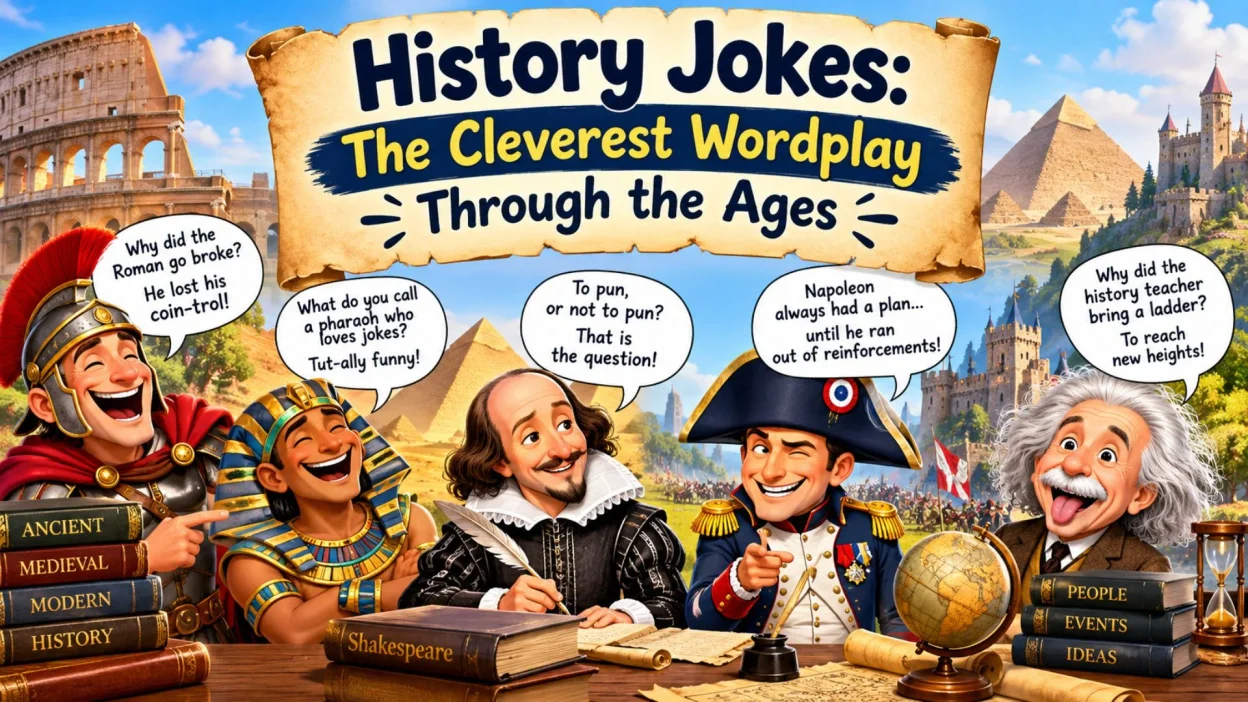
Have you ever noticed that no matter how much time passes, people never stop poking fun at the past? From Caesar to Napoleon, from the pyramids to the Great Wall, history jokes are like fine wine — they get better with age. They work because we’re looking at things that were once deadly serious through the lens of the present moment.
The magic of history jokes lies in contrast. Those stern emperors and generals from textbooks suddenly get pulled into everyday conversation, becoming relatable and hilarious. Take this one: “Why couldn’t Washington sleep? Because he couldn’t lie.” You don’t need a PhD in American history — just knowing the cherry tree legend is enough to crack a smile.
This article opens the door to a world of clean, witty, family-friendly history humor. Whether you’re a teacher trying to wake up a classroom or someone who wants to drop a “smart” joke in the group chat, you’ll find what you need here.
🏛️ Ancient Civilization Jokes: When Mummies Start Cracking Wise
Ancient civilizations are a goldmine for history jokes. Egypt, Rome, Greece — these names practically write their own punchlines.
Ancient Egypt: Dry Humor from the Pyramids
Egyptian jokes revolve around mummies, pharaohs, and that famous Sphinx. These tend to be short and punchy — perfect for meme captions.
- Why did the pharaoh love bragging? Because he sphinx he’s the best.
- How did ancient Egyptians write? In hero-glyphics.
- Why are mummies never in a hurry? They’ve got all the time in the world.
- When you photograph a pharaoh, he says: “Hold on, let me get pyramid-perfect.”
- An ancient Egyptian goes to the doctor. Doctor asks, “What’s wrong?” He says, “Cough, cough — it won’t stop.”
The beauty here is the double meaning. “Sphinx” sounds like “thinks.” “Hero-glyphics” plays on “heroic.” No lengthy explanation needed — one word does all the work.
Ancient Rome: I Came, I Saw, I Made a Pun
Rome gave the world laws, roads, and Caesar salad. Roman jokes split between playing on the name “Caesar” and the empire’s rise and fall.
- How was the Roman Empire cut in half? With a pair of Caesars (scissors).
- Why did the Roman emperor open a barbershop? He wanted to rule the locks.
- Caesar wrote a book called I Came, I Saw, I Punned.
- What did ancient Romans use to cut hair? A good Caesar.
- Why did Roman soldiers never get lost? Because all roads lead to Rome — but they went straight there.
“Hail Caesar” sounds like both a greeting and a weather report about hail. This kind of homophone humor has been around for centuries — nearly every comedian has used a version of it.
Ancient Greece: Where Philosophy Meets Foolery
The Greeks invented democracy, drama, and the marathon. Their jokes carry hidden geometry and philosophy.
- Why did Alexander study geometry? He wanted to conquer all angles.
- Why did Greeks tell stories with letters? They loved alphabetical legends.
- Why do ancient Greek statues have no arms? Holding the chisel was exhausting.
- The Trojan War lasted ten years — all because of a wooden horse joke.
- How did Greeks celebrate victory? They ran a marathon and forgot why they won.
“Conquer all angles” works on two levels — geometric angles and strategic angles. This kind of joke appeals especially to math and philosophy fans.
👑 Medieval Jokes: Knights, Castles, and “Chivalry”
The Middle Ages are a golden age for history jokes — no wait, a “dark age,” because there were too many knights.
Daily Life in Castles and Armor
Medieval humor mostly circles around knightly armor, chilly castles, and the word “chivalry” itself.
- Why were medieval castles so cold? Too many knights inside.
- Why did the medieval knight become a model? He had chivalry.
- What do you call a knight who’s afraid to fight? Sir Render.
- What do you call a medieval spy? Sir Veillance.
- Why did medieval soldiers sleep with one eye open? They were on the knight shift.
“Knights” and “nights” sound identical, so the “Dark Ages” were really the “Knight Ages.” This pun has circulated in English-speaking countries for centuries — it never gets old.
Viking “Norse Code”
Vikings contributed one of the all-time classic history puns.
- How did Vikings send secret messages? In Norse code.
- Where do little Vikings play? In the Norse-ery.
- Why didn’t Vikings use GPS? They trusted their raid-ar instincts.
“Norse code” sounds like “Morse code,” and “Norse-ery” mirrors “nursery.” Simple, direct, and funny without needing any historical background.
🎨 Renaissance & Early Modern: When Art Started Making Puns
The geniuses of the Renaissance probably never imagined people would be playing word games with their names centuries later.
Artists and Their “Finances”
- Why did the Renaissance painter go broke? He had no Monet.
- How long did Da Vinci take to paint the Mona Lisa? One smile at a time — for years.
- How did Michelangelo sculpt David? He just chiseled away.
“Monet” sounds like “money.” In the English-speaking world, this pun is almost a reflex.
Colonial America’s “Tea” Memes
The Boston Tea Party is a goldmine for history jokes because “tea” can be played with endlessly.
- What’s a colonist’s favorite drink? Liber-tea.
- Where was the Declaration of Independence signed? At the bottom.
- Why couldn’t Washington sleep? He couldn’t lie.
- How did Franklin feel when he discovered electricity? Shocked.
- Who was the funniest guy in Washington’s army? Laugh-ayette.
Each of these corresponds to a real historical fact. You laugh — and then realize you’ve accidentally memorized something from a textbook.
🔫 World Wars & Cold War: Finding Lightness in Serious Times
World War humor requires extra care. We’re only including gentle, harmless jokes here — focused on language, not suffering.
Cold War Double Meanings
- Why was the Cold War so cold? Because of Stalin (stalling).
- Why couldn’t Soviets keep secrets? Red alerts everywhere.
- How did Cold War spies communicate? In frozen envelopes.
“Stalin” sounds like “stalling,” so WWII “dragged on” because of “Stalin.” This pun is widely known in English-speaking countries — a classic history double meaning.
WWII Language Games
- What’s special about the French army? They have rearview mirrors.
- Why don’t WWII veterans talk much? They’re afraid of too many memories.
- Who ran the fastest? Mussolini — he was fascist (fastest).
These jokes need some historical context, but for those who know the era, the double meaning hits hard. When sharing, check your audience’s comfort level first.
🇺🇸 American History Jokes: From Revolution to Presidents
American history may be short, but the joke material is plentiful.
Revolutionary Era
- What music did Pilgrims like? Plymouth Rock.
- What do early Americans and ants have in common? They both live in colonies.
- Why did colonists dump tea in the harbor? To throw a tea party.
- What’s funny about the Liberty Bell? It cracked me up.
“Plymouth Rock” perfectly puns on rock music and Plymouth Rock. “Colonies” works for both settlers and ants. For English learners, these jokes double as vocabulary builders.
Presidential Punchlines
- Why did Lincoln wear a tall hat? To be head and shoulders above the rest.
- What’s Obama’s favorite vegetable? Barack-oli.
- Why was Roosevelt always invited to parties? He was bear-y fun.
“Barack-oli” blends “broccoli” with “Barack.” “Bear-y” is a homophone for “very,” paired with Teddy Roosevelt’s bear story — a double pun.
🌍 World History Jokes: Wit Across Time and Space
World history is vast — here are a few most representative regions.
Chinese History
- Why didn’t Qin Shi Huang laugh? He had a burning hatred for bad books.
- How was the Great Wall built? One brick at a time.
- Why did Zhuge Liang always wave a fan? To fan the flames — then cool down.
These jokes land more naturally in Chinese. For English readers, pinyin puns work: “Qin Shi Huang didn’t laugh because he had a burning hatred for bad books.”
Indian History
- Why do Indians love the number zero? Because they invented it.
- Who built the Taj Mahal? A love-struck emperor.
- Why did Gandhi walk barefoot? To stay grounded.
No complex explanation needed — the imagery itself carries the humor.
📱 How to Use These History Jokes (Practical Guide)
Good jokes need good timing. Here are a few tips to maximize the effect of history humor.
Social Media Captions
When posting a history-related photo on Instagram or Facebook, a well-placed history joke turns a boring check-in into “cultured comedy.”
- Posting a pyramid photo: “Sphinx you’ll love this place too.”
- Posting a museum photo: “I’m digging up old punchlines.”
- Posting an old building: “Chivalry never dies.”
Classroom Teaching
If you’re a teacher, slide one joke into your presentation. Research shows humor improves memory retention. Teaching the Roman Empire? Add: “Rome wasn’t built in a day — but jokes are.”
Group Chats and Parties
History jokes are icebreakers. Not everyone needs to know history — one person laughs, others ask “what does that mean?” and suddenly you have a teaching moment — and a chance to show off your knowledge.
Cards and Notes
A birthday card that says “Chivalry never gets old” beats “Happy Birthday” with a dash of cleverness. A retirement card: “Time to Rome freely” — a pun and a warm wish in one.
❓ FAQs
What is a pun?
A pun is a word game that uses a word’s multiple meanings or similar-sounding words to create humor or rhetorical effect. Example: “The history teacher always had dates” — both calendar dates and romantic outings.
Why do people love puns?
The joy of a pun is the aha moment. When the brain processes two meanings at once, it produces intellectual pleasure. Puns are also usually harmless and clean — suitable for all ages.
Are history jokes good for kids?
Absolutely. Every joke in this article is family-friendly with no inappropriate content. In fact, history jokes are a great way to spark kids’ interest in history. After they laugh, they’ll ask “Who was Caesar?” — and you’ve already won half the battle.
Final Thoughts
History jokes are a kind of gentle wisdom. They don’t mock the past — they invite it to a relaxed party. When you tell a friend “Washington couldn’t sleep because he couldn’t lie,” you’re doing two things at once: telling a joke and sharing a story.
The best joke is the one that makes you laugh — and then makes you want to pass it on. So pick your favorite, send it to a friend, your family, or that history teacher who never smiles.
Which history joke is your favorite? Share your “hidden gem” in the comments. If you laughed, don’t forget to share it with someone who needs a smile. History repeats itself — and so should happiness.

Alex Carter is a creative writer and humor enthusiast who enjoys creating clever puns, funny jokes, and entertaining content. He is passionate about bringing fresh ideas and a little laughter to readers through PunsHero.